Author Archives: EVENOR - TECH

How to cluster with other sister projects

The deliverable 7.2. title “Report on clustering with other projects” (Six-Month Draft version) provides information on the coordination with sister projects financed under the theme RUR03. This deliverable has been developed by the partners of UNIBO.

In particular, this document lists the actions carried out during the first 6 months of project activities to establish contacts and promote coordination with the EFFECT and CONTRACTS2.0 project, as well as the main points agreed up to month 6 with the other projects.

Activities carried out in the M1-M6 period to support coordination among projects

To achieve connection, communication and information exchange, the CONSOLE project partners have taken the first steps:

  • First contacts between project coordinators and facilitation of connections between partners working in the same country;
  • Update on deliverables and planned activities;
  • Reciprocal participation of the coordinators in the ABs of the other projects;
  • Joint outreach activities, including a lunch seminar at the EU Commission, at least one organized session at a major academic event, consideration of a joint special issue for a journal;
  • Connection and dissemination of information through website and social media.

As well as a series of activities:

  • Face-to-face meeting at the Coordinators’ day organized on June 6, 2019 in Brussels, between the 3 project coordinators and with the person in charge of policies;
  • A Skype meeting on 23 September 2019 to fine-tune reciprocal initiatives and prepare for the next meeting in Brussels;
  • Face-to-face meeting on the morning of October 16, 2019 in Brussels, between the 3 coordinators of the project;
  • Physical meeting on the afternoon of October 16, 2019 in Brussels, on the occasion of the presentation of the 3 projects to the staff of DG AGRi; Participants include the coordinators, the two project managers and the policy officer, three members of DG Agri staff.

Main activities and coordination strategies

In the deliverable, you will also be able to find the general coordination strategies (Section 3), the adjustment of the case studies, the dissemination events (seminars, workshops and conferences), coordination and research activities, etc.; that will allow you to know clearly and easily the focus of our project.

In summary, we encourage you to consult deliverable D7.2. to know our relationship with other sister projects through strategies and activities in connection and dissemination. These are actions that we are constantly carrying out, to maintain the exchange of knowledge and experiences; and, with it, enrich mutual knowledge.

And don’t forget that you can leave us your comments about this and other deliverables that are always at your disposal on the CONSOLE project website.

 

Delivering multiple environmental benefits in the South Pennines

Summary

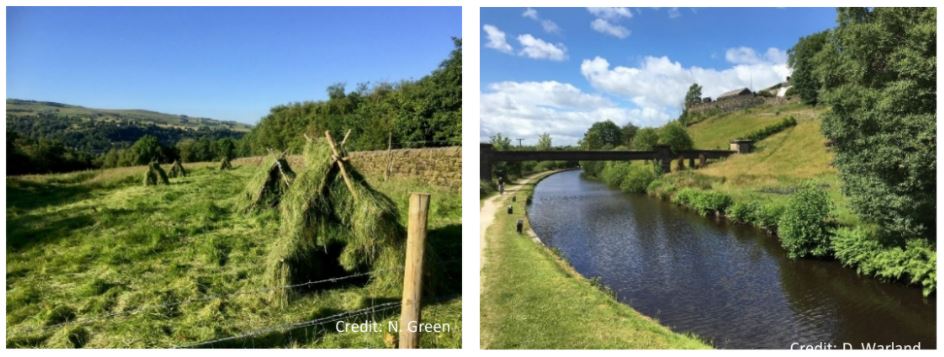
The network was initially set up by a farm advisor who had good contacts with farmers, local authorities and other large landowners. Land managers in this area have previously struggled to access funding because it is not located in a National Park or Area of Outstanding Natural Beauty which receive additional funding from the Government. This is further compounded by the small size of many of the farms which makes it hard for them to apply to certain farm support payment schemes.
A particular highlight of this network was working with a local council that had been allocated £2 million following the 2015 floods. The group worked to ensure £500k was allocated to an Agri-Environmental Scheme (AES) which the network developed and Calderdale Council oversees. The network has also worked with the Woodland Trust to enhance the woodland creation offer.

Objectives

  • Build an informed and cohesive, landscape scale, land management
  • Community
  • Increased woodland management and creation
  • Improved water quality and flood risk in the region
  • Improved grassland and moorland habitat connectivity
  • Development of non-government funding streams for the delivery of ecosystem services in land management
  • Addressing potential issues resulting from sub-optimal land management

Public Goods

Soil quality (and health)
Rural viability and vitality
Water quality
(Farmland) biodiversity
Cultural heritage
Landscape and scenery
Resilience to natural hazards
Delivering multiple environmental benefits in the South Pennines

Problem description

The South Pennines network includes areas of protected status including SSSIs, SACs and SPAs. However unlike many other CSFFs in the Yorkshire region it is not in a National Park so does not benefit from the additional Government funding that those areas receive.
Farming incomes in this area are built on a long history of mixed livelihoods, from weaving on hand looms to working in the mills during the industrial revolution. The requirement for farmers to supplement their income with out-of-farm activities continues, and can lead to sub-optimal land management. The CSFF strives for a
future free from the threat of financial constraints and is aiming for continued land stewardship not intensification of farming.

Olive orchards within the framework of the CONSOLE Project

Agroenvironmental goods in Olive orchards within the framework of the CONSOLE Project

The olive grove is one of the most important crops in Europe, representing almost 70% of the total world production and the main exporter of non-producing areas, such as North America.

In Spain, the olive tree (Olea europaea L.), occupies 2.5 million hectares and represents one of the three traditional historical crops of the country, together with the vine and the cereals (Mediterranean trilogy). However, its survival is in danger because the predictions of climate change models – with an increase in temperatures and a decrease in rainfall – will cause adverse effects on the olive grove in Andalusia, as could be the reduction of the harvests (Lorite, IJ. et al., year?).

<< The occupation of the surface by 91% in the provinces of Jaén and Córdoba >>

Faced with this situation, the policies of the European Union, through the Environmental Action Programs (Decision No 1386/2013 / EU) as a framework for the formulation of environmental policies in the EU, has bet on a sustainable growth of the primary sector.

<< Currently the 8th Environmental Action Program is in force >>

And to achieve these sustainability goals, contractual relationships have proven to be efficient instruments to promote the sustainable management of crops and Agri-Environmental Public Goods (Bartolini et al., 2005; Deliverable 1.3).

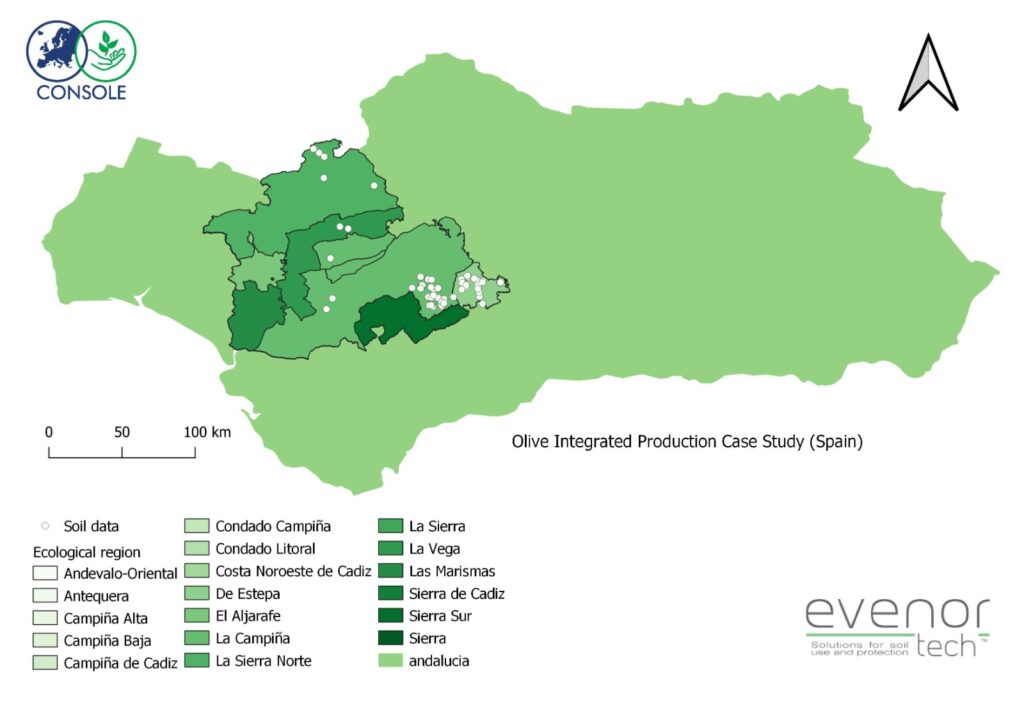
Under the project CONSOLE, the increase in soil carbon sequestration has been analysed within the framework of the Integrated Production System in the Andalusia region as part of the Green Deal and the new objectives of the CAP (REGULATION (EU) 2018/841; Fática and Panzica, 2020).

Integrated production is an agricultural system of plant production that uses agricultural techniques that ensure sustainable agriculture, using integrated pest management methods compatible with the protection of the environment, agricultural productivity and the use of mechanisms and natural production resources (Baroja Hernández, 2003). For this, the first step was the compilation, harmonization and standardization of different data sources (public and private sector).

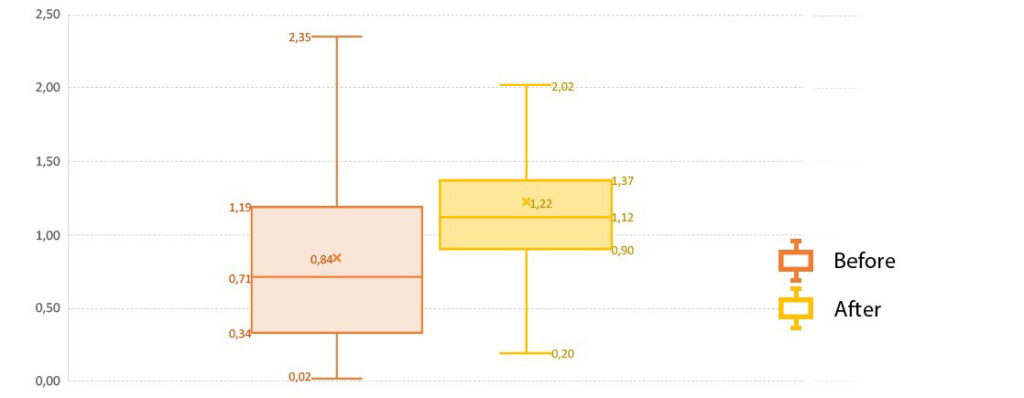
Soil organic carbon changes were analysed by interpolating soil organic carbon data available before the establishment of Integrated Production (1992-95 vs 2017-2020) in 55 commercial plots. In addition, the efficiency and precision of Copernicus were analysed to monitor changes in soil organic carbon.

This analysis includes the application of 16 indices to compare with soil samples (in situ and ex situ data). The soil, the sites and the crop management variables were included in the study to respond to the diversity of the olive grove and facilitate the scale of results (tillage, planting patterns, pH, texture, slope, K, N, P, Ca , etc.).The results showed the increase in COS due to the implementation of Integrated Production in terms of crop and soil management.

Comparison of soil organic carbon before (1990-2000) and after (2010-2020) of applying the Integrated Production to representative Mediterranean benchmark soils under olive crop

The results and methodologies applied in this study will allow and facilitate the implementation of contractual relationships based on results focused on increasing the sequestration of soil organic carbon and, consequently, the mitigation of climate change.

References


  • Baroja Hernández, E. (2003). Producción Integrada. Cuaderno de Campo. Consejería de Agricultura de Desarrollo Económico. Gobierno de La Rioja. Link
  • Bartolini, F., Gallenrani, V., Raggi, M., Viaggi, D. (2005). Contract desing and targeting for the production of public goods in agriculture: the impact of the 2003 CAP reform. XI th congress of the EAAE. Link
  • Deliah, H.A. (2000) The 1992 CAP reforms: a general analisys of its effect on the environment. Institu for Systems, Imformatics and Safety. Joint Research Center. European Commision. Link
  • Fática, S., Panzica, R. (2020). Green bonds and too agrainst climate change? JRC Working Papers in Economics and Finance, 2020/10. European Commision. Link
  • Lorite IJ, Gabaldón-Leal C, Santos C, Cruz-Blanco M, León L, Porras R, Belaj A, de la Rosa R. (año?). Impacto del cambio climático sobre la agricultura andaluza: Olivar. Instituto de Investigación y Formación Agraria y Pesquera. Consejería de Agricultura, Pesca y Desarrollo Rural. Junta de Andalucía. Link
  • Pleguezuelo, C.R.R., Zuazo, V.H.D., Martínez, J.R.F. et al. Organic olive farming in Andalusia, Spain. A review. Agron. Sustain. Dev. 38, 20 (2018). https://doi.org/10.1007/s13593-018-0498-2. Link

Report on European in-depth case studies

Report on European in-depth case studies

On the CONSOLE project website, we want to highlight one of the deliverables that should be consulted by any stakeholder. This is deliverable D2.3, entitled “Report on European in-depth case studies” found within Work Package 2 (WP2)

Deliverable objective

The European In-Depth Studies report provides a brief introduction to the objectives of the deliverable and the tasks addressed. It describes the data collection process in depth and briefly presents the criteria that are the basis for performance evaluation, as well as the types of contract solutions considered in the project. What’s more, provides an in-depth look at 26 in-depth CONSOLE studies.

  • Result-based Nature Conservation Plan (AT)
  • The Results-based Agri-Environment Payment Scheme (RBAPS) Pilot in Ireland (IR)
  • The Humus Program of the Ökoregion Kaindorf (Carbon market) (AT)
  • Biodiversity monitor for dairy farming (NL)
  • ECO-METHANE – Rewarding dairy farmers for low GHG emissions in France (FR)
  • BurrenLife Project (IR)
  • Wildlife Estates Label in Flanders (BE)
  • Carbon Market (Hiilipörssi) – a marketplace for the restoration of ditched peatlands (FI)
  • Incentives for collective reservoirs (IT)
  • Integrated territorial projects (IT)
  • Delivering multiple environmental benefits in the South Pennines (UK)
  • Building natural flood management knowledge and capacity in Wensleydale (UK)
  • Kromme Rijn Collective management (NL)
  • NUTRINFLOW (LV)
  • Participation of private landowners to the ecological restoration of the Pondarea Midden-Limburg/ the 3watEr project (BE)
  • Natural grazing in Podkarpackie Region (PL)
  • Green jointly owned forest TUOHI (FI)
  • “The Wild Farm” organic farmers (BG)
  • BioBabalscy – Organic Pasta Chain Preserving Old Varieties of Cereals (PL)
  • Water protection bread (Wasserschutzbrot) (DE)
  • “Carta del Mulino” – Barilla (IT)
  • Organic wine in Rueda, Spain (Rueda) (ES)
  • Integrated production in the olive groves (ES)
  • Conservation and restoration of grasslands in Strandzha and Sakra mountains for restoring local biodiversity and endangered bird species (BG)
  • Eco-grazing – Grazing for ecological grasslands maintenance in the green areas of Brest Metropole (FR)
  • DVIETE (LV)

Tackled tasks

Deliverable 2.3 reflects the activities carried out in Task 2.2 of the project, which is titled “Data collection, selection and diagnosis of the reasons for the success and failure of initiatives in Europe (M4-M11)”, which has been led by BOKU team and co-led by UNIBO.

The Task T2.2 dealt with data collection and analysis of a large number of selected case studies of exemplary contract solutions in Europe. Data collection and analysis were divided into two levels of diagnostic intensity, which have been defined in the DoA as “first level analysis” and “second level analysis“.

The world-class analysis aims to provide a comprehensive Inventory of contract solution case studies across Europe and beyond; Meanwhile, the Second-level analysis was dedicated to the in-depth evaluation of a small number of selected contract solution case studies, specifically evaluating the framework conditions and contract specifications of successfully implemented contract solutions to improve the provision of AECPG in Europe.

Agri-Environmental-Climate Public Goods (AECPGs) List

Much more content that you cannot miss

The Deliverable 2.3. It is full of high-quality information that you should or should not miss. This is the case of the deep compilation of the case studies and your summary (section 3 Y 4, respectively), the presentation of Agri-Environmental-Climate Public Goods (AECPGs), the Framework conditions and context situation (section 5), and much more.

Download

We make it easy for you to download the deliverable. Just click the button.
And if you want us to inform you on a regular basis, you just have to sign up for our Newsletter.

Natural Grazing in Podkarpackie Region

Summary

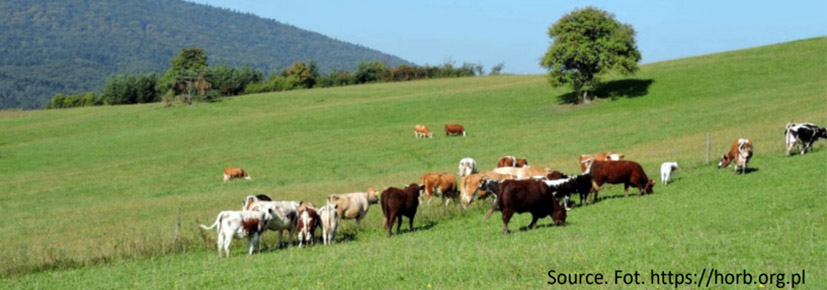
The program “Podkarpacki Naturalny Wypas” was established in 2012 as a public initiative, in order to preserve, protect and restore the biodiversity in valuable natural areas through extensive grazing of livestock in the meadow-pasture areas of the Podkarpackie Voivodeship. The program is coordinated by the Marshal’s Office of the Podkarpackie Voivodeship (Local Government). The program currently runs as a long term initiative (2017-2020). Each year an open call is organized in which non-profit organizations (e.g. foundations, associations, NGO cooperatives) and other eligible parties present offers toarrange grazing on specific grasslands by subcontracted f armers, who provide animals cattle, horses, sheep, goats and deers) and plots of land for grazing. In the pilot year (2012), 7 organizations took part, representing a total of 321 farmers, grazing 5,981 animals on the area of 4,700 hectares. In 2019, there were 7 organizations involved and 715 farmers, grazing on an area of 15,100 ha (about 13,236 animals). The study of Ruda et al. (2019) shows that the program brings measurable benefits. Over half of the interviewed breeders increased the grazed area and number of animals, a significant part systematically performs pasture care activities, or built pastoral infrastructure. The program contributes to the protection of biodiversity in valuable natural areas and brings measurable economic and social benefits.

Objectives

Preservation, protection and restoration of the biodiversity in valuable natural areas, based on extensive grazing of livestock while maintaining animal welfare.
Restoration of valuable natural and landscape areas for grazing.
Maintenance and restoration of architecture associated with traditional pastoral grazing;
Protection of cultural heritage, supporting and sustaining the traditions, customs and other related elements of folk culture of pastoralism;
Economic and tourist activation of the Podkarpackie province.

Public Goods

Farm animal health and welfare
(Farmland) biodiversity
Cultural heritage
Landscape and scenery

Problem description

The program responds to the need for economic and tourist activation of the Podkarpackie Voivodeship, and in particular for the protection of naturally valuable meadow and pasture areas while maintaining biodiversity. Among the factors justifying the implementation of the Program the most important are: a large share of protected areas in the region (44.9% of the total area), a progressive decline in livestock numbers and the low utilization of permanent grasslands (below 50%)

Kromme Rijn Collective management

Kromme Rijn Collective management

Summary

Collective implementation of agri-environmental management has been started up throughout the Netherlands since 2016. After individual management had proven to fail to deliver the desired agri-environmental-climate public goods (AECPGs), a larger-scale implementation of agri-environmental management was considered a more feasible and promising solution. In the central Dutch province of Utrecht, a wide variety of AECPGs is required by society and farmers. This includes improvement of water quality, enhancing and emphasizing the landscape diversity that supports recreation, and providing a habitat for species including bats and owls. In the eastern half of the province, the Kromme Rijn region, the “Agrarisch Natuur Collectief Utrecht Oost” (agricultural nature collective Utrecht East) organizes the large-scale nature management. Land owners are members of the collective, which organizes payment for specific nature management actions performed by farmers, monitors, and brokers between land owners and organizations / companies that implement some specific nature management actions, based on a common regional management plan. The collective is certified by the national certification institute for agri- environmental management and has its own quality assurance controllers.

Objectives

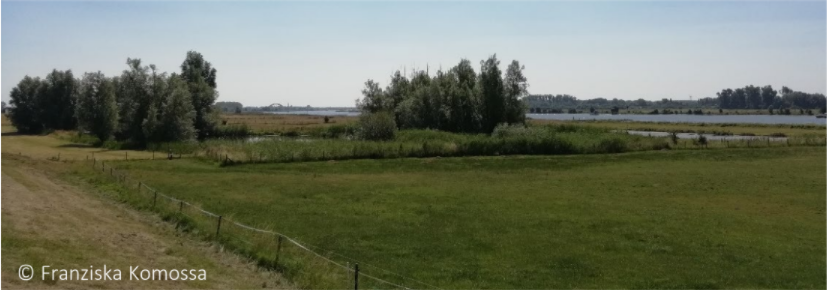
Objectives are set by the provinces. In the case of Kromme Rijn, the province of Utrecht defines targets in its annual nature management plan. Defined are targets for nature, landscape, agricultural nature and landscape management. Landscape management targets at fostering landscape diversity. The ANLM aims at maintaining landscape elements: characteristic on the levees are tree lines, small patches of forests, wooded banks, ponds, and small traditional orchards. The lower and wetter part of the region.
Langbroekerwetering, contains small patches of wet species-rich grasslands that are extensively managed through mowing, combined with tree lines and small fields.
Creating habitat for amphibians, including the great crested newt, for several owls, and several bat species. Creating habitats for threatened species of extensive traditional arable lands.

Public Goods

Water quality
Water quality
Water quality
(Farmland) biodiversity
Cultural heritage
Soil quality (and health)
Landscape and scenery

Problem description

Agri-environmental management has been introduced in the Netherlands in 1975.
1000 km2 were assigned as agriculture-nature area and managed by nature organizations, another 1000 km2 included “normal” farmland, on which farmers planned their farmland and management practices in a nature-friendly way. Since the year 2000, it became increasingly apparent that farm-level agri-environmental management was not effective, because target species required a larger mosaic of land use and land cover than can be provided on a single farm. In 2016, agri- environmental management by nature collectives has been introduced by the Dutch government