Category Archives: Users

LearnedLessons

Lessons Learned

One of the tasks of the research stage of the CONSOLE project is to have a deliverable of the lessons learned (Deliverable 2.4) that are framed within the WP2 work package.

The objectives of the document are to provide lessons learned from a variety of existing (implemented) contractual solutions for the improved delivery of AECPG both within and outside the EU.

And to achieve this objective, a structural approach is adopted:

  1. Introduction to the case studies, analyzing it in terms of the characteristics of the contract, Agro-Environmental-Climate Public Goods addressed (AECPGs), forestry and agricultural systems, contracting alliances, financial parties and payment mechanisms;
  2. Through a qualitative analysis, the contract specifications and the reasons for the success and failure of the case studies are presented;
  3. The reasons for the success of exemplary cases outside the EU and cases beyond the CONSOLE EU case studies (see deliverable 2.2);
  4. General conclusions and recommendations are drawn, taking into account EU case studies, non-EU case studies and in-depth case studies.

Therefore, through this approach, deliverable 2.4 provides information on the specificities and framework conditions that drive the success of the contract solutions presented in the case studies. In addition, the deliverable can provide a knowledge base on what to consider when enhancing contract solutions for enhanced provision of AECPG.
Download

You can download Deliverable 2.4 by clicking the button

World Soil Day 2020

World Soil Day 2020

This year’s theme of the World Soil Day 2020 ‘Keep soil alive, protect soil biodiversity’ is very much at the heart of the CONSOLE project where we are looking at innovative contract solutions for the delivery of environmental public goods.

Only by fostering the interlinkages between farming activities, soil organisms and natural processes from an ecological and a socio-economic point of view a transition to a more sustainable agricultural production is possible.

The CONSOLE factsheets provide a valuable source of voluntary environment and climate measures demonstrating that:

  • encouraging the growth of flowering cover crops, intercrops and perennial crops does not only benefit above ground biodiversity, but is also important for soil organisms which are key for soil quality and health by fostering nutrient cycling, water regulation, and pathogen suppression
  • extensive livestock grazing, in particular in mountainous areas, enhances carbon storage under permanent pasture and reduces the risk of soil erosion
  • maintaining and establishing of landscape elements and non-productive field strips and edges provides valuable habitats and serve as a gene reservoir for soil organisms

You can download some of the CONSOLE project case studies related to soils.

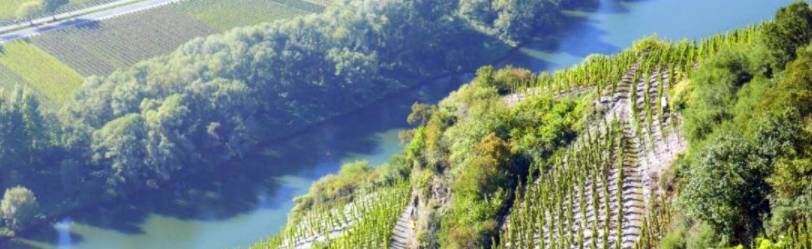
Viticulture on steep slopes creates diversity in the Moselle valley

Case Study: Viticulture on steep slopes creates diversity in the Moselle valley

Summary

Measures promoting species diversity in viticulture on steep and extremely steep slopes have been developed in collaboration with winegrowers. At the same time these measures contribute to the preservation of the traditional cultural landscape along the river Moselle..

Objectives

The preservation and promotion of biodiversity by winegrowers in cultivated steep and extremely steep slopes stays in the foreground. This is done by:
• seeding wild plants for greening the interrows of vineyards and field borders
• establishment of floristic and faunistic hotspots
• clearance of shrubs of abandoned vineyards as well as safeguarding the attractive landscape for tourism of the Moselle valley.

Public Goods

Rural viability and vitality
Landscape and scenery
Recreational access
Viticulture on steep slopes creates diversity in the Moselle valley

Problem description

The project has been initiated as a reaction to the loss of flora and fauna typical for the Moselle vineyards and the need of specific protection measures, especially for endemic species like the Apollo butterfly.

Overview of main contract types

Contract types

During these months, in the CONSOLE project we are making known the 58 case studies, from 13 European countries (2 case studies in non-European countries) in which we are carrying out our project through the information sheets. In them, you can find a series of data from more than 70 experts and interested parties.

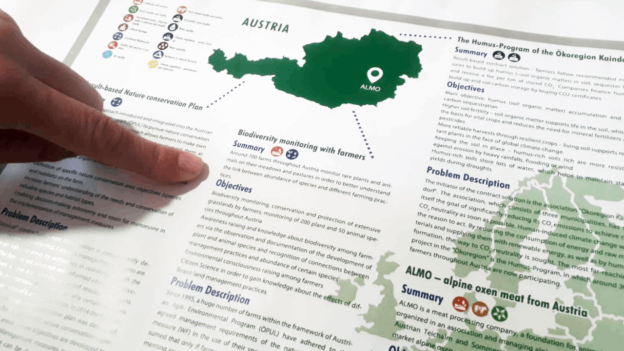
The information structured in Infoboxes

These information sheets are structured in infoboxes in the margins of the pages that allow a quick understanding – and through the use of icons – of the types of contract, characteristics, public goods, payment mechanisms, duration of the contract, etc.

The four types of contracts

In this publication we want to present the four main types of contract of the CONSOLE project:

Result-based/result-oriented contracts

Results-based / Results-oriented (RB / RO)

Contracts that specify an environmental / climate result as a benchmark (in RB solutions, results are the benchmark Even for payments).

Collective implementation/cooperation

Collective implementation / cooperation (CO / COOP)

Contracts Implementation of a formalized cooperation between farmers / actors to deliver AECPG (in CO solutions, even payments are issued collectively and then distributed among members of the collective).

Value chain-based contracts

The value chain Contracts based on the (CV)

Contracts that connect the delivery of AECPG with the production of private goods.

Land tenure-based contracts

Land tenure-based contracts (LT)

Land tenure arrangements with environmental clauses.

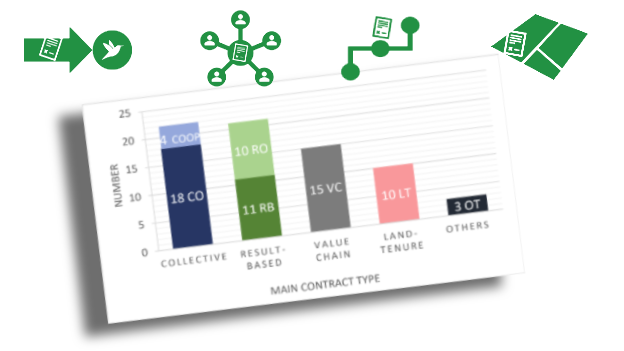
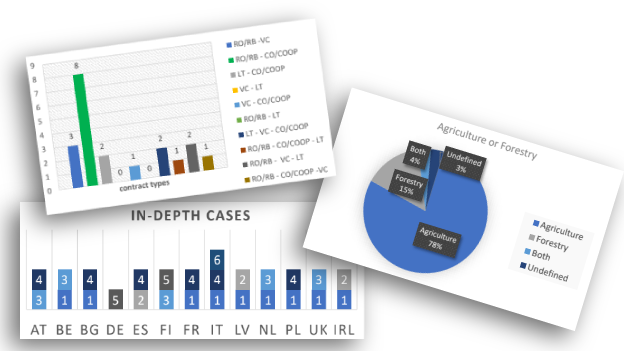
Figure shows that 22 contract solutions are assigned to the main contract type of collective implementation/cooperation (CO/COOP), including 18 cases representing collective implementation and 4 representing cooperations. Five collective case studies are double-counted because a second main contract type is involved. CO/COOP contract solutions are thus the most numerous in the project closely followed by result-based/result-oriented (RB/RO) solutions (21 cases). The distribution of RB and RO contract solutions in the RB/RO pillar is nearly half/half; 11 of the contract solutions are explicitly result-based, 10 contract solutions are result-oriented contracts. Again, 7 RB/RO contract solutions are characterised by incorporating a second main contract type. 15 case studies are assigned to the contract type group of value chain (VC) based solutions; 10 case studies belong to the group of land tenure (LT) based contracts (4 case studies each includes a second main contract type). Finally, there are 3 case studies which are not directly assignable to one of the four contract types, therefore, they are assigned to an additional category named “others”.

Case Studies

Selection of case studies

In principle, CONSOLE case studies are examples of existing, innovative and effective contract solutions aimed at improving the provision of AECPGs.
However, for the purposes of covering failures, CONSOLE case studies can also represent real life proposals of contract solutions that for some reasons have never arrived at the stage of generating impact, but that can provide relevant insights (e.g. measures that opened calls without participation, contract proposals with no uptake, measures proved impossible due to regulatory constraints at EU level, etc.)

Moreover, a CONSOLE case study is a case of real implementation of a specific contract “type”. In accordance with the CONSOLE deliverable D1.1. contract solutions suited to be a case study in CONSOLE are:

  • land tenure-based: tenure-related prescriptions, e.g. environmental clauses in tenure contracts;
  • result-based/result-oriented (synomym: output-based/output oriented):contracts specifying a result (e.g. the delivery of a specific AECPG serves as reference parameter for payment)
  • collective implementation/cooperation: formalised cooperation among farmers/actors in view of delivering AECPGs
  • value chain-based: delivery of AECPGs in connection with private goods provision, e.g. contracts between value chain partners for the delivery of AECPGs connected to product specificities.

Also contract solutions representing combinations or hybrids of these contract “types” are suited to be case studies in CONSOLE. Practice- or action-based contracts, today’s dominating approach, have been excluded on purpose. Still there are some contrat solution case studies that contain practice-based elements, for example where the payments are (partly) based on management prescriptions.

Besides representing real cases of contract types emphasised by CONSOLE, additional requirements have been considered:

The CONSOLE cases studies cover:

  • different types of contract partnerships / contracting parties (public -private, private – private, civil society – private, public – private – civil society, …);
  • different AECPGs (biodiversity, soil conservation, agricultural landscapes, climate, …);
  • different conditions of land ownership;
  • different types of agriculture (grassland, permanent crops, arable land, etc.);
  • different types of forestry (continuous cover forestry, drained peatlands, etc.);
  • different geographical locations;
  • different types of interplay between different public goods (single, multiple, combined in landscape);
  • different aspects of the interplay between private and public goods:jointness, independence, competition for resources.

Additional information

You can get more information about the case studies by clicking on the button

Conservation of grasslands and meadows of high natural value through support for local livelihoods

Case Study: Conservation of grasslands and meadows of high natural value through support for local livelihoods

Summary

The agri-environmental measures are maintaining pastures and meadows, by mowing in a timetable throughout the year and limited mowing, affecting endangered breeding birds, European ground squirrel and raptors (King Eagle and Long-legged buzzard).

Objectives

  • To protect the local biodiversity in the area: breeding birds, European ground squirrel and raptors.
  • To encourage the involvement of farmers into schemes for biodiversity conservation.

Public Goods

Rural viability and vitality
Landscape and scenery
(Farmland) biodiversity
Conservation of grasslands and meadows of high natural value through support for local livelihoods

Problem description

The main driving force for this project was the need to assess which agri- environmental measures can be suitable in High-nature value pastures, so that farmers would be motivated to initiate their implementation. The need comes from the fact that there is a seriously high risk of destruction of the habitats of important breeding birds and European ground squirrel with direct effect also on predatory birds. The most serious problem leading to the loss of valuable habitats is the gradual conversion of pastures and meadows into vineyards.