Author Archives: EVENOR - TECH

Program “Sheep Plus” - Provincial Program of Economic Activation and Preservation of the Cultural Heritage of the Beskids and Kraków-Częstochowa Upland

Program “Sheep Plus” – Provincial Program of Economic Activation and Preservation of the Cultural Heritage of the Beskids and Kraków-Częstochowa Upland

Summary

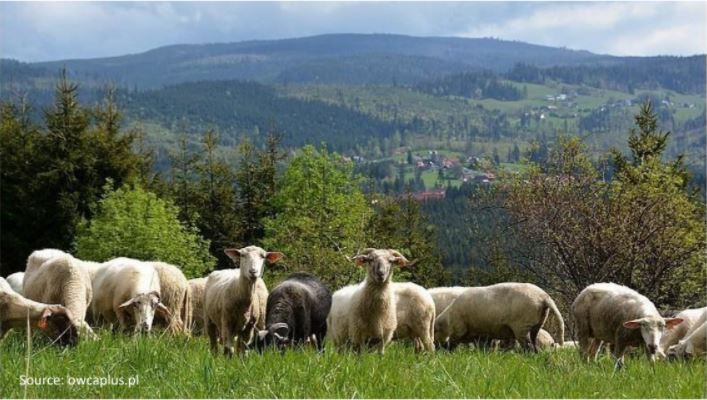
The program “Owca Plus” was established in 2008 as a public initiative in order to preserve, protect and restore the biodiversity in valuable natural areas, through extensive grazing of sheep in the meadow-pasture areas of the Śląskie Voivodeship. The program is coordinated by the Marshal’s Office of the Śląskie Voivodeship (Local Government). The program currently runs as a long term initiative 2015-2020 with a total budget exceeding 1 mio. Euro. Each year an open call is organized in which non-profit organizations (e.g. foundations, associations, NGO cooperatives) and other eligible parties present offers to arrange grazing on specific areas of land by subcontracted farmers, who provide animals (sheep and goats) and plots of land for grazing. The list of recommended areas offered for grazing by the program includes 168 plots in the Beskids and 73 plots of the Kraków- Częstochowa Upland. The bidding organizations assure grazing on the area covering at least 550 ha of land in Beskids or at least 100 ha in Kraków-Częstochowa Upland. There are two organisations representing over 100 farmers, grazing about 4-6 thousand animals on over 600 hectares of land. The program brings measurable environmental, cultural and economic benefits. The outcomes of the environmental monitoring showed significant improvement of biodiversity. In the economic aspect, the tourist infrastructure was modernized and expanded to improve the accessibility and attractiveness of the areas included in the program. Thanks to the implementation of the program, the sheep population increased and the availability of meat and sheep products expanded. The program has indirectly contributed also to the development of tourism (by an increase in the number of entities offering accommodation, meals, employment in tourist services, trade and transport).

Objectives

  • Preservation, protection and restoration of the biodiversity in valuable natural areas, based on extensive grazing of sheep and goats while maintaining animal welfare;
  • Maintenance and improvement of valuable natural habitats and species, depending on agricultural, especially pastoral use;
  • Restoration of valuable natural and landscape areas for grazing
  • Protection of local breeds of farm animals;
  • Maintenance and restoration of architecture associated with traditional pastoral grazing;
  • Protection of cultural heritage, supporting and sustaining the traditions, customs and other related elements of folk culture of pastoralism.

Public Goods
(Farmland) biodiversity
Farm animal health and welfare
Landscape and scenery
Cultural heritage
Cultural heritage
Program “Sheep Plus” - Provincial Program of Economic
Activation and Preservation of the Cultural Heritage of
the Beskids and Kraków-Częstochowa Upland
Program “Sheep Plus” – Provincial Program of Economic Activation and Preservation of the Cultural Heritage of the Beskids and Kraków-Częstochowa Upland

Problem description

The gradual disappearance of sheep grazing observed over the years due to a significant reduction in the demand for sheep products (wool, cheese, meat) almost irreversibly affected the overgrowing of naturally valuable areas of the Beskids and the Kraków-Częstochowa Upland with expansive plant species and self-sown trees.
This, in turn, led to the impoverishment of nature that may cause irreversible changes in the traditional landscape, depriving it of, among others tourist values. The program, introduced in 2008, responds to the needs for preservation of natural and cultural heritage of the Śląskie Voivodeship, and in particular for restoration of pastoral economy in the Beskids and Kraków-Częstochowa Upland, in order to stop adverse natural changes, as well as to protect the cultural heritage of these areas.

Green Deal Dutch Soy

Green Deal Dutch Soy

Summary

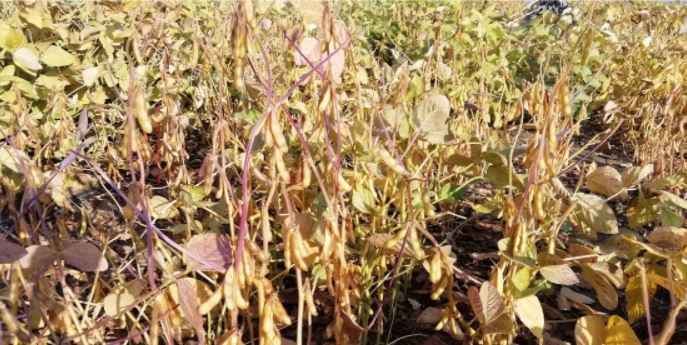
The Gree Deal Dutch Soy is a contract between national government, regional governments, a soy processer / feed producer, and farmers. They aim at establishing a viable production chain for soy in the Netherlands, by identifying the most suitable varieties and ensuring a solid soy production volume that allows a viable chain, with fair
prices for soy farmers. Being a legume crop, soy can sequester nitrogen in the soil, with that reducing the need for fertilizers in the follow up crop and benefiting soil quality in the long run. Furthermore, increasing the soy area in the Netherlands can have a positive impact on biodiversity. The Green Deal Dutch Soy is a set of non-binding commitments.

Objectives

  • The Green Deal Dutch Soy aims to realise 10 000 ha/year harvested area and an average yield of at least 3500 kg/ha.

Public Goods

(Farmland) biodiversity
Climate regulation - carbon storage
Climate regulation – carbon storage
Climate regulation - carbon storage
Climate regulation – carbon storage
Quality and security of products
Soil quality (and health)
Green Deal Dutch Soy

Problem description

Green deals have been established in the Netherlands to stimulate entrepreneurship and to enable entrepreneurs and societal partners to test and implement green solutions in a bottom-up, solid, quick, but robust way. They aim to overcome bureaucratic and related time consumption barriers that normally hamper innovation. The specific Green Deal Dutch Soy specifically responds to the unsustainable soy production standards in the current Dutch trade partners for this crop.

Public_R_D_and_European

Public R&D and European agriculture: impact on productivity and return on R&D expenditure

Assessing the contribution of public investments in agriculture and research in agricultural production in Europe is the aim of the scientific publication recently accepted by our project partners Meri Raggi and Davide Viaggi; as well as a Michele Vollaro (University of Bologna, Italy)

To develop the journal article, they have taken into account two fundamental elements:

The first is found in a “literature review” on the connection between public investment, development (R&D) and agricultural productivity.

In a second place the “Availability and Selection of data“, which summarizes spending on agricultural R&D and agricultural productivity measures.

Methodology

The methodology proposed by the researchers begins by arguing the lack of a common established and consensus in the methodologies that study the impact of agricultural R&D on the economy; of which they make a magnificent review of the various approaches of the authors or of the various geographical regions (as is the case of Europe and the United States).

For the research, they analysed the impact of public R&D on agricultural productivity at the aggregate level, using data from 16 representative countries. With these data, the RoR (agricultural productivity and rates of return) of public spending on research in Europe was estimated.

Likewise, the authors emphasize the cost-benefit analysis as an effective methodology to evaluate the economic impact on the computation of R&D investments.

Results

Obviously, we will not show the results of the research in this post, although we will make some clarifications.

Southern European countries support the hypothesis that agricultural research is more adaptive rather than basic, and expect research on this topic to be shorter than the suggested 50 years.

The results have shown positive and negative effects; as well as the need to include more variables that could affect agricultural productivity, such as climate, meteorological anomalies, private investment in research, etc.

However, the results corroborate the hypothesis that research spending has a generally positive impact on productivity.

Download the paper

The authors have made the article already approved by the publisher available to everyone.
We encourage you to read it, since you only have to click on the button.

DVIETE LIFE

DVIETE LIFE

Summary

LIFE+ project “Restoration of Corncrake habitats in Dviete floodplain Natura 2000 site ” 2010-2015
The Nature Park and Natura 2000 site ‘Dviete floodplain’ was established in 2004 and covers an area of 4,989 hectares. It is one of the largest and best-preserved functioning river floodplains, and one of the most important breeding areas of the Spotted Crake, Corncrake and Great Snipe in Latvia. It is also a globally important stop-over site for waterfowl during spring migrations. The area and biological quality of Dviete floodplain grasslands have been remarkably decreased by alteration of the hydrological regime during the 20th century. Drained and abandoned grasslands overgrown with bushes, becoming unsuitable for the breeding of the Corncrake and other protected grassland bird species. Some measures have been taken to improve the conservation status of Corncrake
(Crex crex in Latvia). For example, the straightened section of the river Dviete with a length of about 2 km has been restored in its natural hydrological regime of the flood plain favourable to the corncrake, by preventing overgrowth of the surrounding grassland and to increase the common biodiversity of the flood plain. Shrubs and trees on an area of at least 100 ha were removed in cooperation with the landowners to restore the corncrake’s habitats – open floodplain grasslands. By removing shrub barriers, a continuous area of approximately 300 ha of corncrake habitat was restored. The contracts were signed in the project for the restoration of the meadows and grazing of biologically valuable grasslands.

Objectives

  • Restoration of a straightened section of the Dviete River to its natural bed above Lake Skuķu to improve the hydrological conditions of the floodplain and prevent overgrowth of the meadows while restoring the historical floodplain landscape;
  • Restoration of floodplain grasslands by cutting shrubs and trees overgrown with them;
  • Establishment of grazing areas for cattle and horses in restored floodplain meadows for their subsequent maintenance in a state suitable for meadow birds.

Public Goods

(Farmland) biodiversity
Landscape and scenery
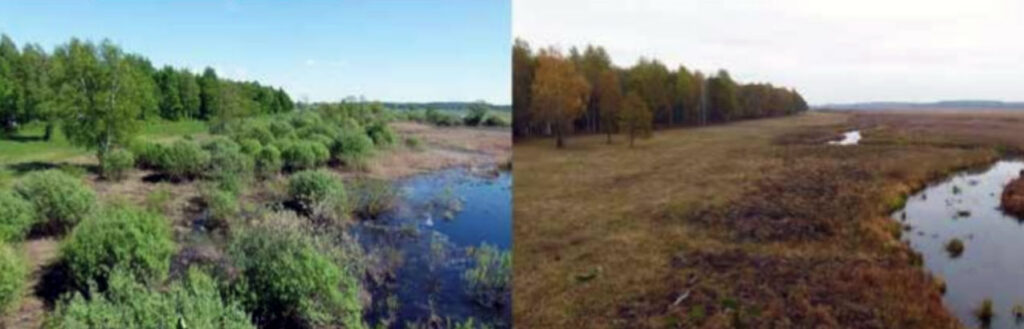
Dviete floodplain landscapes before and after restoration of grasslands (24.05.2011. and
22.10.2015). Photo: E. Račinskis

Problem description

During the 20 century, natural values of the Dviete floodplain suffered from the straightening of watercourses, drainage of wetlands, intensification of agriculture and later also the abandonment of grasslands. Parts of Dviete floodplains of former grasslands are overgrown with shrubs and trees, losing their importance to both grassland birds and migratory waterfowl. Shortly after the creation of the Dviete Floodplain nature park, a nature protection plan for the site was developed in 2005 as part of the LIFE project “Restoration of Latvian floodplain meadows for the conservation of EU priority species and habitats” (LIFE04NAT / LV / 000198; 2004- 2008). One of the objectives of the plan was to restore the hydrological regime of the drained floodplain. This included restoring river bends in the floodplain following existing stretches of old riverbeds, and gradual downstream restoration. After the implementation of the project, the area needs to be agriculturally maintained under consideration of environmental aspects.

Cooperative Management of Ecosystem Services: Coalition Formation, Landscape Structure and Policies

Cooperative Management of Ecosystem Services: Coalition Formation, Landscape Structure and Policies

In the blog post on the CONSOLE project, we want to recommend a post by Francois Bareille, Matteo Zavalloni, Meri Raggi and Davide Viaggi; being developed during Related Project LIFT (Low-Input Farming and Territories – Integrating knowledge for improving ecosystem-based farming ).

The Summary ago reference to the important role of farmers in the management of ecosystem services, thus relating to part of the objective pursued by CONSOLE. The bibliographic review, as the authors indicate, points to a benefit for those actors who act in a coordinated way, compared to those who are not coordinated.

However, the public good nature of these ecosystem services may hamper the emergence of a cooperative solution at the landscape scale.

There are no doubts that biodiversity and ecosystem services depend on the structure of the landscape, which are related to the decisions of farmers. For example, maintaining the connectivity of natural habitats (ecological corridors).

For instance, they are habitats of pollinators or insect predators of pests -, which contribute to the value of the harvest.

Research objectives

The objective of the research was threefold:

  1. The first was to look for the size and composition of stable coalitions of farmers willing to cooperate with pollination services, and to what extent they produce economic gains.
  2. The second objective was to investigate the role of landscape structure in cooperation and conservation outcomes.
  3. Finally, the last objective was to evaluate how the different public policies aimed at habitat conservation affect the stability of the coalition. In addition, the researchers wanted to know if a policy design that encourages cooperation among farmers would lead to improvements in budget effectiveness.

To achieve the purposes, they formulated a spatially explicit bioeconomic model of nine farmers who can dedicate part of their arable land to semi-natural habitats (flowers, hedges, etc.)

Consult the journal article

To consult this journal paper, you just have to click on the button..

Cooperation in Natura 2000 area benefiting biodiversity

Cooperation in Natura 2000 area benefiting biodiversity (Measure 16.5)

Summary

This operation targets effective interventions for biodiversity protection in areas with Natura 2000. These environmental efforts require synergic and coordinated actions to protect biodiversity, primarily removing any critical issues that may exist in the Natura 2000 areas (coming from the implementation of measures by the Habitats and Birds directives). The cooperative approach allows to reach specific objectives not effectively achieved with individual interventions. This method starts with a “mutual agreement” phase, where the involvement of the largest number of beneficiaries is required. It evolves in the creation of a “local cooperation agreement”, approved by the local competent authority for biodiversity.

Objectives

  • Safeguarding, restoring and improving biodiversity in Natura 2000 areas.

Public Goods

(Farmland) biodiversity
Landscape and scenery
Cooperation in Natura 2000 area benefiting biodiversity (Measure 16.5)

Problem description

The driving force of this measure is “Safeguarding, restoring and improving biodiversity, in Natura 2000 areas and in areas subject to natural or specific obligations “. The RDP and therefore the political region has supported during the last three Rural Development Programs (from 2000 to 2019) measures that push towards a more careful approach toward protected area.
It is important, for the purpose of maintaining a sustainable management and moreover for the restoration of forest, agricultural ecosystems and natural/semi-natural habitats, to financially support farmers who actually have a low-income due to the protection of natural areas.